
Spending other people's time
Or - the asymmetry of asking

Hey, can I grab 30 minutes of time to chat about the roadmap?”. An innocent, well-meant message, but the recipient now has to context-switch out of the problem they were solving, check their calendar, find a slot, wonder what this is about, and sit in a meeting that could have been three bullet points in a message. Time to write the ask: 8 seconds. Total cost to the company, somewhere between 45 minutes and the rest of the day.
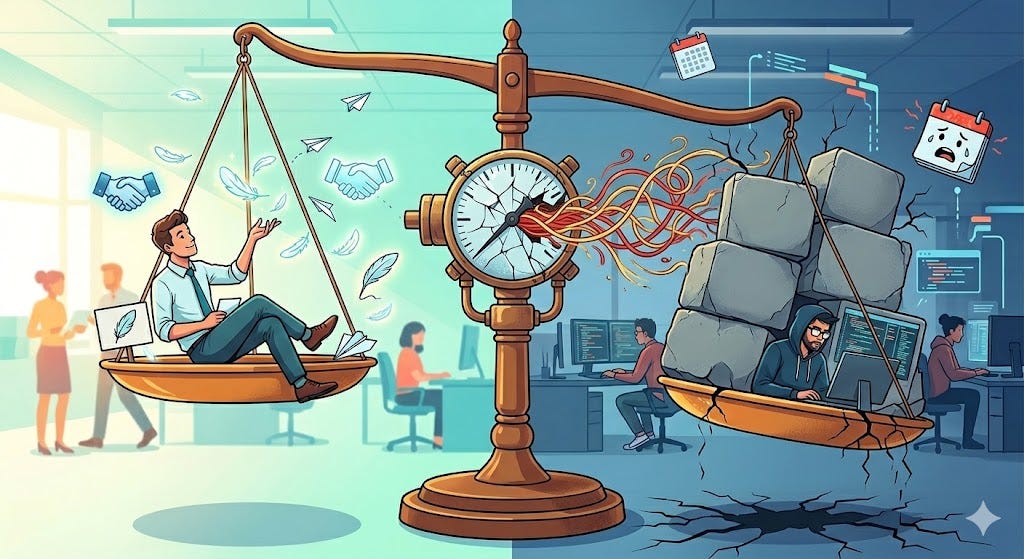
Asking for someone’s time is virtually free for the asker yet enormously expensive for the person being asked. This scenario plays out in multiple guises: the telephone call, the email or the well-meaning pull request. And it’s a system design flaw that compounds across entire organizations.
The economics are broken
When you ask someone for a meeting, you want to make a trade. Your question for their time. But this trade isn’t symmetric at all; you know what you want, they don’t. You’ll leave your meeting and get on with the rest of the day; they will need to rebuild whatever mental state they were in before your interruption.
In queueing theory terms, this is a system where the arrival rate is decoupled from the processing cost, and there’s no feedback mechanism to slow things down. In any other system, we’d call this a design flaw and fix it. In organizations, we call it “collaboration”.
The Externality of Effort
Economists have a term for when your actions impose costs on someone else: a negative externality. A factory pollutes a river. The factory bears none of the cost; the people downstream bear all of it.
Time works the same way.
When you open a pull request, you’re not just offering code, you’re issuing an invoice for someone else’s attention. When you send a meeting invite to eight people for a one-hour meeting, you haven’t spent one hour of the company’s time. You’ve spent eight. When you send a Slack message to a channel of fifty people, you’ve just made a withdrawal from fifty attentional bank accounts, and you didn’t need anyone’s approval to do it.
The common thread is that the sender controls the transaction, but the receiver pays the cost. And unlike money, you can spend other people’s time without their consent.
The AI Amplifier
This problem is about to (perhaps already has?) get much worse, and the reason is simple: AI has made generation nearly free while leaving evaluation just as expensive as it ever was1. I’ve written about how this applies to code, but it applies to everything from the quickly written AI-generated email. pull request or “strategy”.
People use AI for good reasons, but they’re effectively shifting their “productivity” onto other people’s shoulders as a cost. It’s a denial-of-service attack on human judgement.
The Politeness Trap
What makes this hard to talk about is that the people spending your time usually mean well. The LinkedIn request comes from someone who genuinely wants to connect2. The pull request comes from someone who genuinely believes they’re helping. The meeting invite comes from someone who genuinely thinks everyone needs to be there. The AI written multi-page treatise that could have just been a shared prompt.
And so, we’ve developed an unspoken norm that it’s rude to push back. It’s rude to decline the call. It’s rude to say “this PR is too large to review.” It’s rude to question whether a meeting needs all eight attendees. It’s rude to ask “did Claude write that?”. The social cost of protecting your own time is high, because the person spending it didn’t intend to impose.
But intent and impact are different things. A driver doesn’t intend to create traffic by entering an already-congested motorway, but they do. The problem is structural, not moral.
So, what would a better system look like?
The instinct here is for me to write a list of tips. But you know them all already. Write fewer words. Schedule fewer meetings. Make small PRs. All of these things sound like they’ll help, but they’re basically asking individuals to resist a system that incentivises the opposite behaviour!
What would it look like to truly redesign the system?
Make the costs visible
Time costs are invisible to the person creating them. What if every meeting invite displayed the total person-hours being requested? What if every pull request showed an estimated review time? What if Slack showed you the aggregate attention-minutes your message just consumed? Make negative externalities visible!
Create friction where it’s cheap, and remove it where it’s expensive
The current system is backwards. It’s easy to make a meeting, raise a PR or send an email with a 4000-word attachment. Let’s flip it. Meetings should require an agenda before being scheduled. PRs should explain why things have changed and give guidance on reviews. Don’t share the AI-generated doc; share the prompt. Slack should stop you spamming @here in channels with hundreds of people in.
Price time like the scarce resource it is
Some organisations have experimented with internal “attention budgets” where each team gets a fixed allocation of hours they can request from other teams per sprint. Go over budget, and you need to make a trade: which of your existing requests will you drop? This works because it introduces the constraint that real markets have and organisational calendars don’t. When asking is free, demand is infinite. When asking has a cost, people self-prioritise.
The interesting second-order effect is that teams start investing in self-service. If asking the platform team, a question costs you from your budget, you’re suddenly very motivated to make sure the docs are good enough that you don’t need to ask.
Build systems that answer instead of asking humans to evaluate
If the most expensive thing in your organisation is human attention, then every recurring question that hits a person’s inbox is a system design failure. This is where AI agents actually earn their keep: by absorbing the evaluation load that humans currently bear.
A Slack bot that intercepts “how do I deploy to staging?” before it reaches the platform team, and answers it from the runbook, isn’t reducing collaboration. It’s eliminating a transaction that shouldn’t have involved a human in the first place.
The mental model shift here is important: most organisations think about AI as a generation tool (it helps you produce more). But the higher-leverage use is as an absorption tool: it handles the incoming demand that would otherwise consume someone’s attention. Stop using AI to create more work. Start using it to intercept work before it reaches a human.
Shifting the balance
The old norms assumed that producing something was hard, so anything produced was probably worth someone’s attention. AI has broken that assumption, but our systems haven’t caught up. We’re still running organisations where demand on human attention is unmetered, unpriced, and invisible.
This is a system level problem.
Organizations that win in this new world, won’t be the ones that ask people to be more considerate (“try harder” seldom works). Instead, it’ll be the organizations that design systems where the considerate thing is the easy thing. That means making the cost visible, putting friction in the right places and where the default path protects attention instead of consuming it.
The bullshit asymmetry principle is really similar to this phenomenon, the problem is that AI is better at generating bullshit and wrapping it up in a way that takes even longer to unpick. With AI-assisted work, I think the intent is positive!
I’m not sure I even believed that when I wrote it. But let’s pretend it’s true.