
The Overton window
Only a narrow band of ideas are considered sensible at any given time.

My first job after my PhD used CD binders as version control. Weekly burn to a CD, filed away neatly. Version control of sorts! When I suggested we try the Extreme Programming practices I’d been reading about they looked at me like I’d proposed something dangerous. Their model of “proper engineering” didn’t have a slot for these ideas. We couldn’t even discuss them!
That’s the Overton window in action.
Invisible constraints in your org
Every organization has a narrow band of ideas considered sensible at any given moment. Ideas within that band can be discussed, but anything that falls outside that band is “too risky” or “we’re not that kind of company”.
That spectrum of ideas you can discuss is the Overton window1.
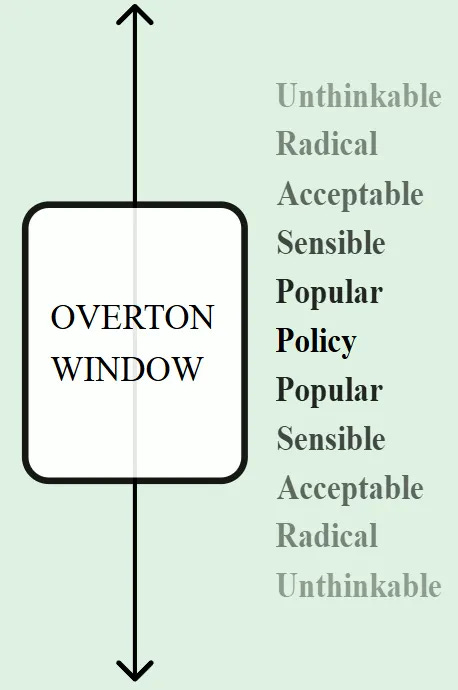
In a software org, the Overton window is drawn around what the culture currently believes is possible and permissible.
A Short Engineering Parable: Continuous Delivery
How does a heretical idea become a hygiene factor? Consider CI/CD’s journey up the ladder.
In the 1990s, continuous delivery was unthinkable—Windows 95 shipped on floppy disks. Multi-year release cycles were standard. Then Kent Beck’s Extreme Programming Explained and Martin Fowler’s writing on continuous integration made the idea radical: discussed at conferences, but not in boardrooms.
The shift to acceptable crystallized in June 2009 when Flickr’s John Allspaw and Paul Hammond presented “10+ Deploys Per Day” at Velocity—the talk that inspired Patrick Debois to coin “DevOps.” Humble and Farley’s Continuous Delivery (2010) and The Phoenix Project (2013) made it sensible. DORA’s Accelerate research made it popular by proving elite performers deploy on-demand and recover faster. Now regulatory bodies encourage automated deployment gates—what was once reckless is now policy.
If you suggested returning to quarterly big-bang releases today, that would be unthinkable. The idea didn’t change. The system did. The window moved up the ladder, one rung at a time.
How to Move the Window
Using the Overton window as a model, you can apply familiar tactical change patterns: create small, undeniable proof with contained experiments; reduce cognitive load by killing projects and eliminating needless friction; make success loud and contagious; shape the narrative; and make the right things easy and the wrong things hard.
That narrative point matters more than it sounds. When a Redgate intern’s deployment error accidentally replaced our entire product download page with copies of the Spotify installer, we told that story openly - not as a cautionary tale about intern supervision, but as a lesson about learning from failure. Change the story and ideas move up a rung without anyone suffering a PowerPoint deck.
Systems change incrementally. If an idea is currently Unthinkable and you announce it as Policy, the system will revolt. You’ll get passive resistance, quiet sabotage and performative compliance. Instead, work the rungs: Unthinkable → Radical → Acceptable → Sensible → Popular → Policy.
But not every idea outside the window deserves to be inside it. Sometimes the window reflects hard-won organizational learning. The judgment call is distinguishing “we tried this and it genuinely doesn’t fit” from “we’ve never tried this and assume it can’t work.” If you’re not sure which you’re facing, dig into the history before you start pushing.
How to Know the Window Is Actually Moving
Changing the system is hard. It’s not like there’s a linear metric to track or a single KPI. Ultimately, you’re looking for those underlying assumptions to change.
Language shifts. “We’d never do that” becomes “maybe for one service.” “That’s risky” becomes “what would we need in place to try it?”
Experiments from unexpected places. Ideas start bubbling up from teams you didn’t push. People copy-paste patterns from early adopters.
Different reactions to incidents. Less blame, more curiosity. “How do we make this the last time?” instead of “who did this?”
New joiners as signals. If hires from modern environments are constantly frustrated, your window is narrow. If they quickly influence ways of working, you’ve got room to move.
These are leading indicators that the system (and therefore the window) is shifting.
Your Actual Job
If you can see the Overton window in your organization, you can move it. Watch for the shifts in language, the experiments bubbling up unbidden, the blame giving way to curiosity. These tell you the window is opening. Keep working the rungs, and ideas that were once radical quietly become obvious.
The model was partly built to resist the idea that think tanks should just lobby politicians. The argument was lobbying moves individuals, but changing the window moves the entire playing field, thus you should influence culture, not politicians. Sadly, it’s not played out like that, and now politicians deploy this as a manipulation technique to try and deliberately move the window. Read more at https://www.mackinac.org/OvertonWindow for more resources.